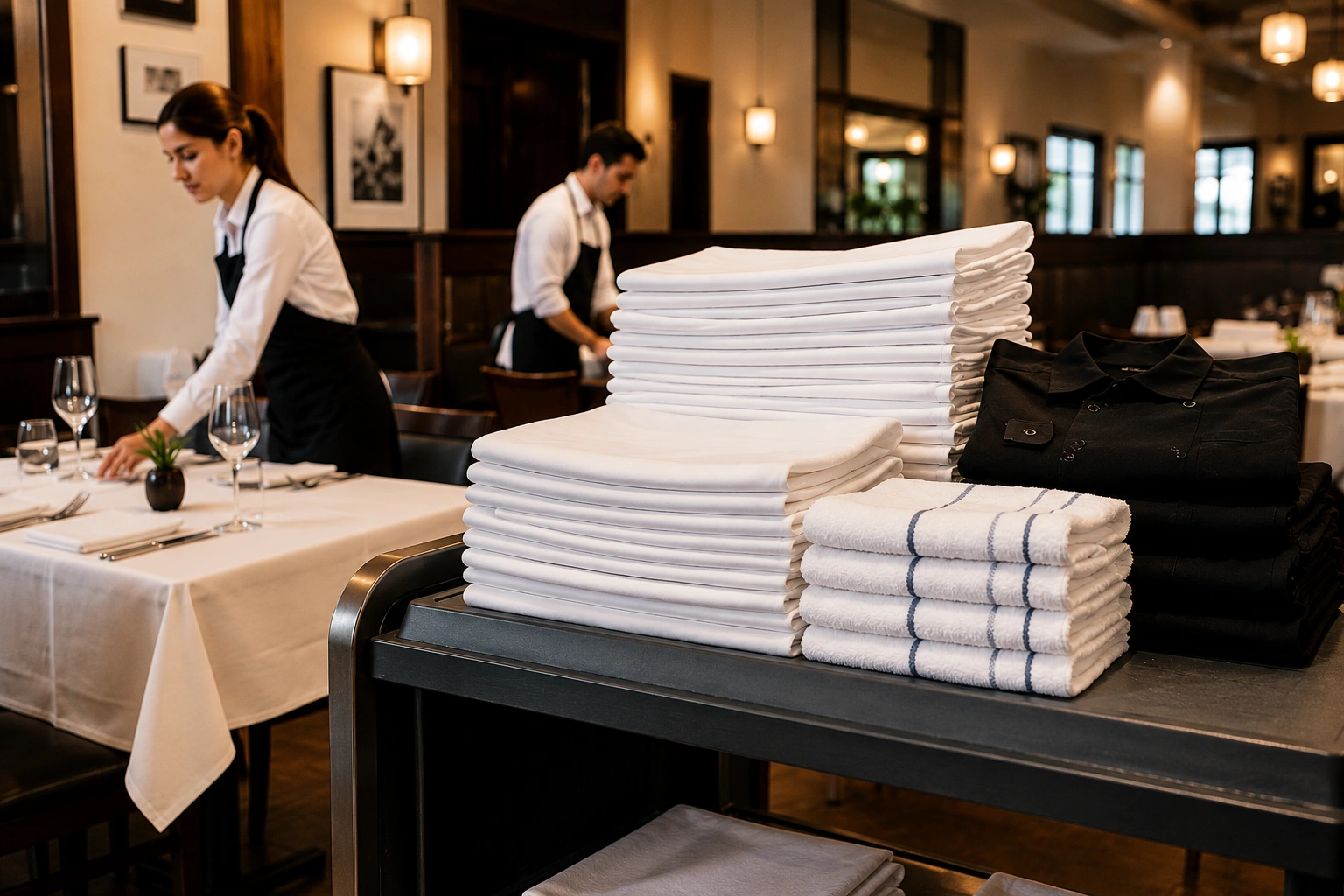
Why Laundry Becomes a Bigger Problem During Peak Season
Laundry volume doesn't always increase gradually with customer volume.
Consider a restaurant that normally turns its dining room twice during an evening. During peak season, it may add larger parties, private events, additional seating, patio service, or extended hours. Every additional table can mean another set of napkins and linens entering the laundry cycle.
Event venues have similar challenges. A wedding on Saturday may require dozens of tablecloths and hundreds of napkins. By Sunday morning, the venue may need another complete set ready for a brunch, reception, or corporate event.
Then there are the less visible items.
Kitchen towels accumulate throughout every shift. Aprons become stained. Staff uniforms need cleaning. Bar towels, polishing cloths, service linens, and other reusable textiles continuously move from clean storage to service and then into the laundry pile.
When business gets busier, the time available to deal with all of it usually gets smaller.
That's where a dependable commercial laundry system becomes important.
Know How Much Linen Inventory You Actually Need
One of the easiest ways to run into trouble during peak season is having too little inventory.
If a restaurant needs almost every available napkin to make it through a busy Saturday night, there is very little room for error. A delayed wash cycle, unexpected private party, damaged linens, or unusually busy service can suddenly leave the business short.
Restaurants and venues should have enough inventory to keep operations running while another batch is being cleaned.
That doesn't necessarily mean purchasing enormous amounts of extra linen. It means understanding actual usage.
Track how many tablecloths, napkins, towels, aprons, and other items are typically used during busy shifts or events. Then consider how quickly those items can realistically return to service.
A healthy inventory creates breathing room between "used" and "clean and ready."
And during peak season, breathing room is a rather lovely thing to have.
Separate Laundry by How It's Used
Throwing every dirty textile into one giant pile might save a few seconds at the end of a shift. It usually creates more work later.
Restaurants generate several very different types of laundry.
Dining room linens may include tablecloths, cloth napkins, runners, and specialty linens. Kitchen laundry can include towels, aprons, cleaning cloths, and other heavily used items. Staff uniforms may require different washing and drying methods altogether.
Separating these categories as they're collected makes the laundry process easier to manage and helps prevent heavily soiled kitchen items from being mixed unnecessarily with guest-facing linens.
It also makes inventory easier to understand.
If clean napkins are disappearing faster than expected, management can see the problem before someone discovers it while setting a table for twelve.
Treat Stains Quickly
Restaurants are essentially professionally organized stain-generating facilities.
Wine, coffee, tomato sauce, grease, salad dressing, chocolate, butter, sauces, makeup, and countless other substances eventually find their way onto linens.
The longer many stains sit, the harder they can become to remove.
During busy service, employees obviously can't stop everything to perform elaborate stain treatments on individual napkins. But having a simple collection process can help.
Heavily stained items can be separated or identified when practical rather than buried inside a large bag of ordinary laundry. That gives them a better chance of receiving appropriate attention during cleaning.
Proper stain treatment can also extend linen life. Replacing commercial linens repeatedly because stains have become permanent gets expensive surprisingly quickly.
Create a Predictable Laundry Schedule
Waiting until you're almost out of clean linens is not a laundry strategy. It is an emergency with fabric involved.
Peak-season laundry works better when cleaning happens on a predictable schedule.
Restaurants may need service several times per week depending on their volume. Busy event venues may need laundry coordinated around their event calendar, especially during weekends with consecutive bookings.
The goal is simple: clean inventory should return before existing inventory reaches a critical level.
A consistent schedule also makes staffing and planning easier. Managers know when laundry leaves, when clean items are expected back, and approximately how much inventory should be available for upcoming service.
This becomes particularly valuable around holidays, wedding season, graduation season, corporate event periods, and other times when demand can remain high for weeks.
Don't Turn Restaurant Employees Into a Laundry Department
It's tempting to handle laundry in-house because it seems straightforward.
There are washers. There are dryers. Someone puts things in them.
Human civilization has repeatedly discovered that processes described this way tend to become considerably more complicated in practice.
Commercial laundry requires employee time for sorting, loading, transferring, drying, folding, stain treatment, storage, and maintaining equipment. Someone also has to remember when loads are finished while simultaneously doing the job they were actually hired to do.
During a slow afternoon, that might be manageable.
During peak season, employees are already needed for food preparation, customer service, cleaning, setup, breakdown, stocking, and dozens of other tasks.
Every hour spent managing laundry is an hour that isn't being spent on the customer experience or another revenue-producing activity.
For many businesses, outsourcing commercial laundry isn't simply about getting clothes and linens washed. It's about removing an entire recurring task from the team's workload.
Consistency Matters to Customers
Guests may never compliment a restaurant because its napkin was exceptionally clean.
They will notice when it isn't.
Clean, fresh linens contribute quietly to the overall impression of a restaurant or venue. Tablecloths should look crisp. Napkins should feel clean. Staff uniforms should look professional. Towels and other visible textiles shouldn't appear stained or worn.
This becomes even more important for event venues.
Weddings, anniversaries, corporate dinners, and celebrations are often photographed extensively. A stained tablecloth isn't just visible for one evening anymore. It can achieve immortality in someone's wedding album.
Consistent professional cleaning helps businesses maintain the presentation customers expect, even when laundry volume increases dramatically.
Plan Around Your Event Calendar
Restaurants often have reasonably predictable busy periods. Event venues may have dramatic changes in laundry demand from one day to another.
A venue might host a small weekday meeting followed by a 200-person wedding and then another large event the next afternoon.
Laundry planning should therefore be connected to the event schedule.
Look ahead at upcoming events and estimate linen requirements before the week begins. Large events, unusual table configurations, specialty linens, or consecutive bookings should be identified early.
The worst time to discover that Sunday's event requires 150 napkins is Saturday night when 140 of them are sitting in laundry bags.
A little forecasting prevents a remarkable amount of unnecessary chaos.
Watch for the Warning Signs of a Laundry Bottleneck
Laundry problems usually provide warning signs before they become emergencies.
You may notice employees constantly asking whether certain linens are clean. Managers may start purchasing emergency replacements. Laundry piles may grow faster than they can be processed. Staff may stay late to finish loads, or clean inventory may regularly arrive just before it's needed.
Another common sign is inconsistent quality. When everyone is rushing, stains get missed, items are folded poorly, or damp laundry gets left sitting longer than it should.
If laundry regularly requires last-minute heroics, the system probably needs to change.
Peak season should increase revenue, not create a weekly contest to see who can locate the last clean tablecloth.
How Commercial Laundry Service Helps During Peak Season
A professional commercial laundry service gives restaurants and event venues additional capacity without requiring additional laundry equipment or employee labor.
Instead of scheduling staff around washers and dryers, businesses can establish a consistent process for collecting dirty laundry and receiving clean, folded items back.
That can be especially valuable when volume changes seasonally.
A restaurant might operate comfortably during slower months but struggle once holiday parties and seasonal traffic begin. An event venue might have relatively little laundry during one part of the year and enormous volume during wedding or event season.
Commercial laundry service provides a way to handle that increased workload without turning a temporary seasonal spike into a permanent in-house infrastructure problem.
Make Peak Season Easier With Tip Top Laundry
At Tip Top Laundry, we understand that commercial customers need more than clean laundry. They need reliability.
Restaurants and event venues operate on schedules that don't leave much room for missing linens, overflowing laundry piles, or employees spending valuable time folding towels and napkins.
A dependable commercial laundry service can help keep table linens, towels, uniforms, and other washable items moving through a consistent cleaning cycle so they're ready when your business needs them.
Whether you're preparing for a busy restaurant season, a packed event calendar, or simply looking for a better way to handle your ongoing commercial laundry, Tip Top Laundry can help simplify the process.
Because your busiest season should be about serving more customers, hosting more events, and growing your business.
Not wondering whether someone remembered to move the towels into the dryer.